Compound reference
Specifications
- CAS number
- 910463-68-2
- Molecular formula
- C187H291N45O59
- Molecular weight
- 4113.6 g/mol
- Sequence
- H-His-Aib-EGTFTSDVSSYLEGQAAK*EFIAWLVRGRG-OH (K* = Lys acylated with C18 diacid-γGlu-2×OEG)
- Research area
- Metabolic / incretin
- Form
- Lyophilised powder
Reference identifiers describe the named compound; they do not verify a supplier lot or its salt form.
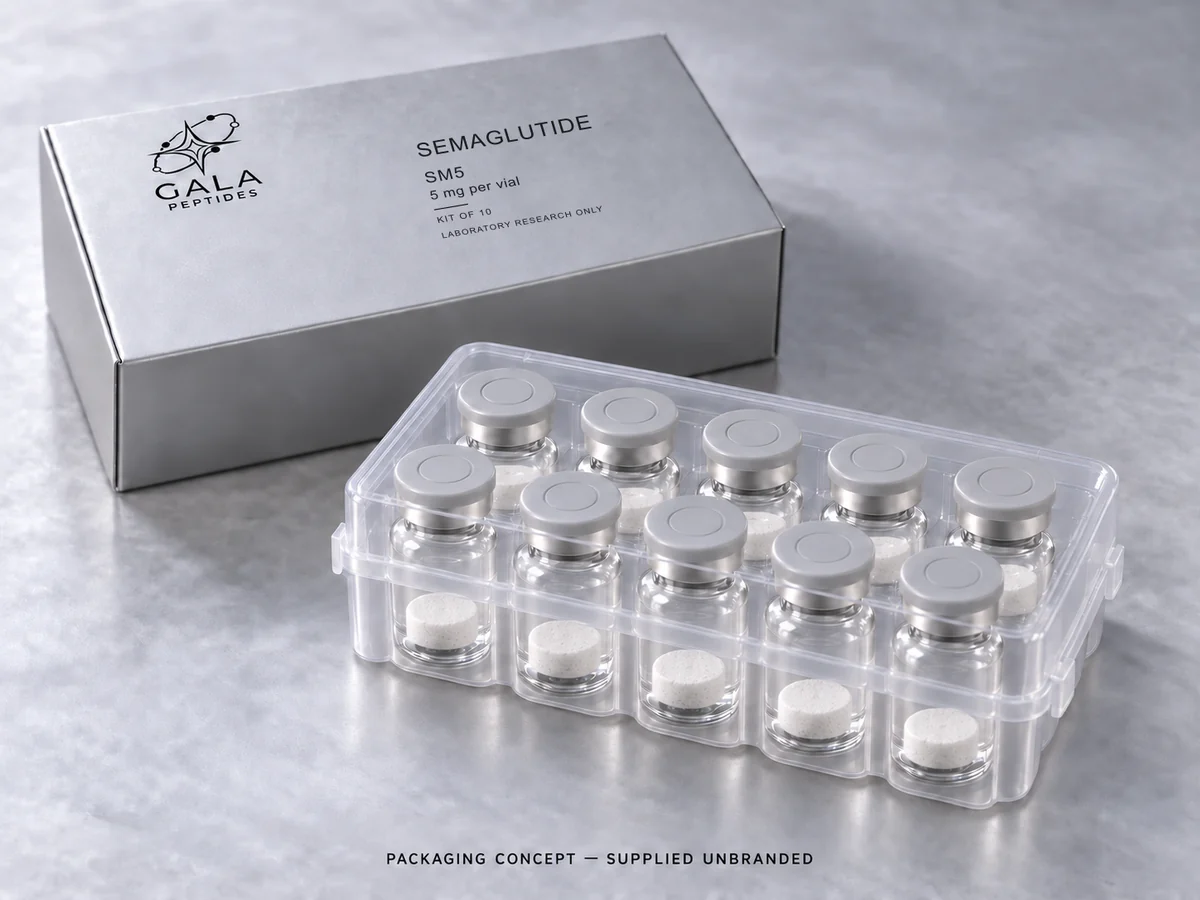
Research kit / SM5
Semaglutide
Acylated synthetic analogue of human GLP-1 studied in models of glucose regulation and appetite signalling.
- SKU
- SM5
- Amount per vial
- 5 mg
- Unit of sale
- Kit of 10 vials
Shipping excluded. Supplied in plain, unbranded packaging.
For experimental laboratory research only. Not for human or animal use.
Documentation
Certificate of analysis availability may vary by product and lot. Contact us before payment to check availability for your selected kit.
All kit prices
| SKU | Per vial | USD / kit |
|---|---|---|
| SM5 | 5 mg | $76≈ $8 per vial |
| SM10 | 10 mg | $106≈ $11 per vial |
| SM15 | 15 mg | $140≈ $14 per vial |
| SM20 | 20 mg | $160≈ $16 per vial |
| SM30 | 30 mg | $200≈ $20 per vial |
Research reference
Reconstitution concentration
Concentration maths for laboratory solutions. Use the mass of one vial and the final solution volume.
Prefilled from the selected SKU. For blends, this is the total mass per vial.
Assumes the entered volume equals the final prepared solution volume.
Enter positive values to calculate.
Solubility and storage depend on the compound. See the guide.
Literature reference
Research overview
What it is
Semaglutide is a synthetic analogue of glucagon-like peptide-1, investigated through the GLP-1 receptor. Molecular modifications include an amino-acid substitution and a lysine-linked acyl group. Medicinal chemistry research examined enzymatic stability, albumin association and receptor activity as separate properties of the analogue. Semaglutide is an active ingredient in FDA-approved medicines; that approval does not extend to Gala research kits.
Where it has been studied
Lau and colleagues described structure–activity work, laboratory pharmacology and preclinical evaluation of candidate analogues. Knudsen and colleagues reviewed the development programme within the broader history of GLP-1 peptide engineering. Wilding and colleagues reported a phase 3 study in participants with overweight or obesity. The selected literature connects molecular design with receptor activation, peptide–protein interactions, stability and exposure. The development review synthesises earlier work, while the medicinal chemistry and clinical papers report original investigations.
Open questions
Questions include how tissue context and receptor trafficking influence responses, and which molecular properties explain differences between experimental preparations. Albumin binding, assay composition and species-dependent biology affect comparisons of laboratory measurements. Experimental systems addressing stability, receptor signalling or exposure measure different aspects of the analogue. Relating these measurements requires attention to the material and conditions used in each study.
References
- Lau et al. Discovery of the Once-Weekly Glucagon-Like Peptide-1 (GLP-1) Analogue Semaglutide. Journal of Medicinal Chemistry, 2015. PMID: 26308095. DOI: 10.1021/acs.jmedchem.5b00726.
- Knudsen et al. The Discovery and Development of Liraglutide and Semaglutide. Frontiers in Endocrinology, 2019. PMID: 31031702. DOI: 10.3389/fendo.2019.00155.
- Wilding et al. Once-Weekly Semaglutide in Adults with Overweight or Obesity. New England Journal of Medicine, 2021. PMID: 33567185. DOI: 10.1056/NEJMoa2032183.
Reviewed 2026-10-09 · References describe published study materials; they do not verify supplied lots.