Compound reference
Specifications
- Also known as
- Copper tripeptide-1 · Prezatide copper · GHK-Cu complex
- CAS number
- 89030-95-5
- Molecular formula
- C14H22CuN6O4
- Molecular weight
- 401.91 g/mol
- Sequence
- GHK (Gly-His-Lys)
- Research area
- Skin & cosmetic
- Form
- Lyophilised powder
Reference identifiers describe the named compound; they do not verify a supplier lot or its salt form.
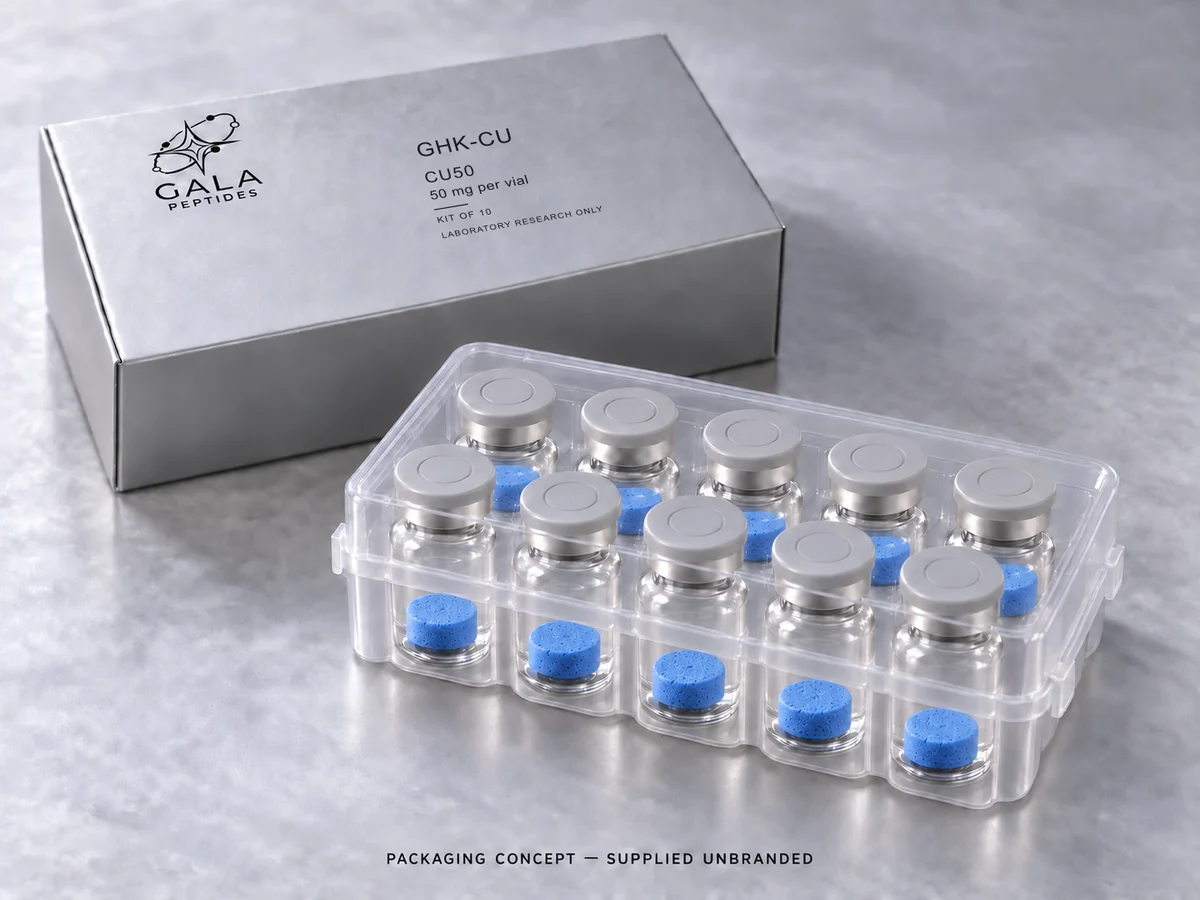
Research kit / CU50
GHK-CU
Copper(II) complex of the endogenous tripeptide glycyl-L-histidyl-L-lysine, studied in models of wound healing, extracellular-matrix remodelling and skin biology.
- SKU
- CU50
- Amount per vial
- 50 mg
- Unit of sale
- Kit of 10 vials
Shipping excluded. Supplied in plain, unbranded packaging.
For experimental laboratory research only. Not for human or animal use.
Documentation
Certificate of analysis availability may vary by product and lot. Contact us before payment to check availability for your selected kit.
All kit prices
| SKU | Per vial | USD / kit |
|---|---|---|
| CU50 | 50 mg | $66≈ $7 per vial |
| CU100 | 100 mg | $125≈ $13 per vial |
Research reference
Reconstitution concentration
Concentration maths for laboratory solutions. Use the mass of one vial and the final solution volume.
Prefilled from the selected SKU. For blends, this is the total mass per vial.
Assumes the entered volume equals the final prepared solution volume.
Enter positive values to calculate.
Solubility and storage depend on the compound. See the guide.
Literature reference
Research overview
What it is
GHK-Cu is the copper(II) complex of the tripeptide glycyl-L-histidyl-L-lysine. GHK was isolated from human plasma and has an affinity for copper ions. The complex is a coordination compound whose chemistry depends on peptide–metal interactions, rather than a peptide agonist defined by one established receptor. GHK without copper and its copper complex are distinct materials for research comparisons.
Where it has been studied
Maquart and colleagues examined collagen synthesis in cultured fibroblasts. Wegrowski and colleagues studied sulfated glycosaminoglycan synthesis in cell culture, addressing a different component of extracellular matrix biology. A later Maquart publication investigated connective tissue accumulation in a rat experimental wound-chamber model. The selected evidence comprises cell-culture and rodent studies with distinct measurements and controls. Their shared themes are matrix production, connective tissue composition and cellular responses associated with a peptide–copper complex.
Open questions
Questions include how copper coordination changes across media, which responses depend on the intact complex and how results compare with peptide-only or copper controls. Cellular background, the available copper pool and the chosen measurement influence interpretation. Collagen and glycosaminoglycan assays examine different matrix components. Chemical characterisation and independent replication support comparisons of observations across experimental systems.
References
- Maquart et al. Stimulation of collagen synthesis in fibroblast cultures by the tripeptide-copper complex glycyl-L-histidyl-L-lysine-Cu2+. FEBS Letters, 1988. PMID: 3169264. DOI: 10.1016/0014-5793(88)80509-x.
- Wegrowski et al. Stimulation of sulfated glycosaminoglycan synthesis by the tripeptide-copper complex glycyl-L-histidyl-L-lysine-Cu2+. Life Sciences, 1992. PMID: 1522753. DOI: 10.1016/0024-3205(92)90504-i.
- Maquart et al. In vivo stimulation of connective tissue accumulation by the tripeptide-copper complex glycyl-L-histidyl-L-lysine-Cu2+ in rat experimental wounds. Journal of Clinical Investigation, 1993. PMID: 8227353. DOI: 10.1172/JCI116842.
Reviewed 2026-10-09 · References describe published study materials; they do not verify supplied lots.