Compound reference
Specifications
- Also known as
- LY3437943
- CAS number
- 2381089-83-2
- Molecular formula
- C221H342N46O68
- Molecular weight
- 4731.33 g/mol
- Sequence
- Y-Aib-QGTFTSDYSI-αMeL-LDKK*AQ-Aib-AFIEYLLEGGPSSGAPPPS-NH2 (K* = Lys17 acylated with C20 diacid-γGlu-AEEA)
- Research area
- Metabolic / incretin
- Form
- Lyophilised powder
Reference identifiers describe the named compound; they do not verify a supplier lot or its salt form.
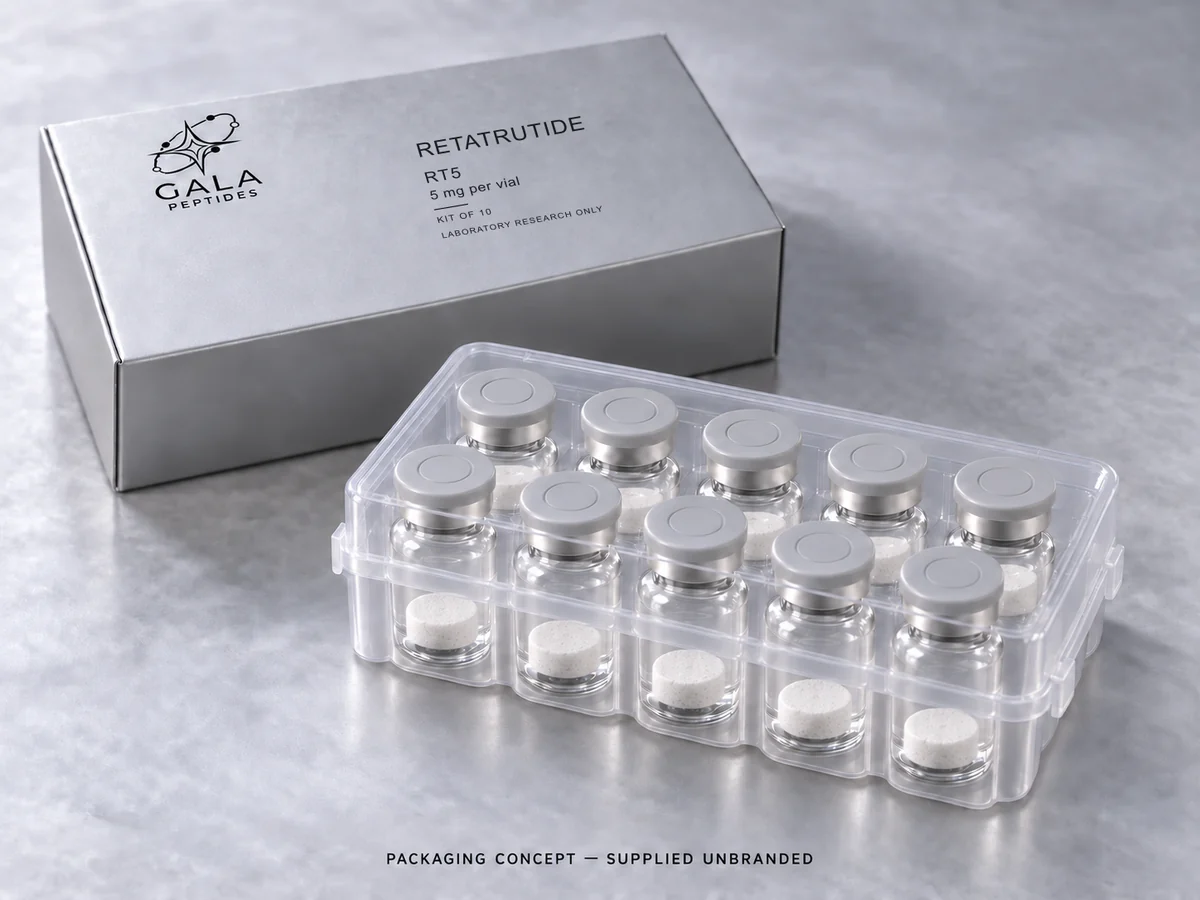
Research kit / RT5
Retatrutide
Triple GIP, GLP-1 and glucagon receptor agonist peptide studied in models of energy balance and body-weight regulation.
- SKU
- RT5
- Amount per vial
- 5 mg
- Unit of sale
- Kit of 10 vials
Shipping excluded. Supplied in plain, unbranded packaging.
For experimental laboratory research only. Not for human or animal use.
Documentation
Certificate of analysis availability may vary by product and lot. Contact us before payment to check availability for your selected kit.
All kit prices
| SKU | Per vial | USD / kit |
|---|---|---|
| RT5 | 5 mg | $136≈ $14 per vial |
| RT10 | 10 mg | $190≈ $19 per vial |
| RT15 | 15 mg | $220≈ $22 per vial |
| RT20 | 20 mg | $244≈ $24 per vial |
| RT30 | 30 mg | $347≈ $35 per vial |
| RT40 | 40 mg | $439≈ $44 per vial |
| RT50 | 50 mg | $521≈ $52 per vial |
| RT60 | 60 mg | $593≈ $59 per vial |
Research reference
Reconstitution concentration
Concentration maths for laboratory solutions. Use the mass of one vial and the final solution volume.
Prefilled from the selected SKU. For blends, this is the total mass per vial.
Assumes the entered volume equals the final prepared solution volume.
Enter positive values to calculate.
Solubility and storage depend on the compound. See the guide.
Literature reference
Research overview
What it is
Retatrutide, originally designated LY3437943, is a synthetic peptide investigated as an agonist at three receptors: the glucose-dependent insulinotropic polypeptide receptor (GIPR), glucagon-like peptide-1 receptor (GLP-1R) and glucagon receptor (GCGR). These targets participate in metabolic signalling with distinct cellular distributions and downstream pathways. Its discovery programme combined peptide engineering with receptor assays to characterise activity across the three targets. The triple-agonist description identifies this target set; the measured balance of activity depends on the experimental system.
Where it has been studied
Coskun and colleagues reported in vitro receptor pharmacology, experiments in obese mice and early clinical investigation. Urva and colleagues described a phase 1b study in participants with type 2 diabetes. Jastreboff and colleagues reported a phase 2 study in participants with obesity. The selected papers examine receptor activity, pharmacokinetics, glucose regulation, energy balance and tolerability across these settings. Their phases identify the cited studies, rather than the latest development milestone.
Open questions
Research questions include the contribution of each receptor, the influence of tissue context and how signalling changes over time. Separating direct receptor activity from subsequent metabolic adaptation helps comparisons across models. Longer observation periods and different study populations provide further questions about the persistence and generalisability of observations.
References
- Coskun et al. LY3437943, a novel triple glucagon, GIP, and GLP-1 receptor agonist for glycemic control and weight loss: From discovery to clinical proof of concept. Cell Metabolism, 2022. PMID: 35985340. DOI: 10.1016/j.cmet.2022.07.013.
- Urva et al. LY3437943, a novel triple GIP, GLP-1, and glucagon receptor agonist in people with type 2 diabetes: a phase 1b, multicentre, double-blind, placebo-controlled, randomised, multiple-ascending dose trial. The Lancet, 2022. PMID: 36354040. DOI: 10.1016/S0140-6736(22)02033-5.
- Jastreboff et al. Triple-Hormone-Receptor Agonist Retatrutide for Obesity - A Phase 2 Trial. New England Journal of Medicine, 2023. PMID: 37366315. DOI: 10.1056/NEJMoa2301972.
Reviewed 2026-10-09 · References describe published study materials; they do not verify supplied lots.