Compound reference
Specifications
- Also known as
- TH9507 · GHRH(1-44) · Egrifta
- CAS number
- 218949-48-5
- Molecular formula
- C221H366N72O67S
- Molecular weight
- 5135.86 g/mol
- Research area
- GH secretagogue
- Form
- Lyophilised powder
Reference identifiers describe the named compound; they do not verify a supplier lot or its salt form.
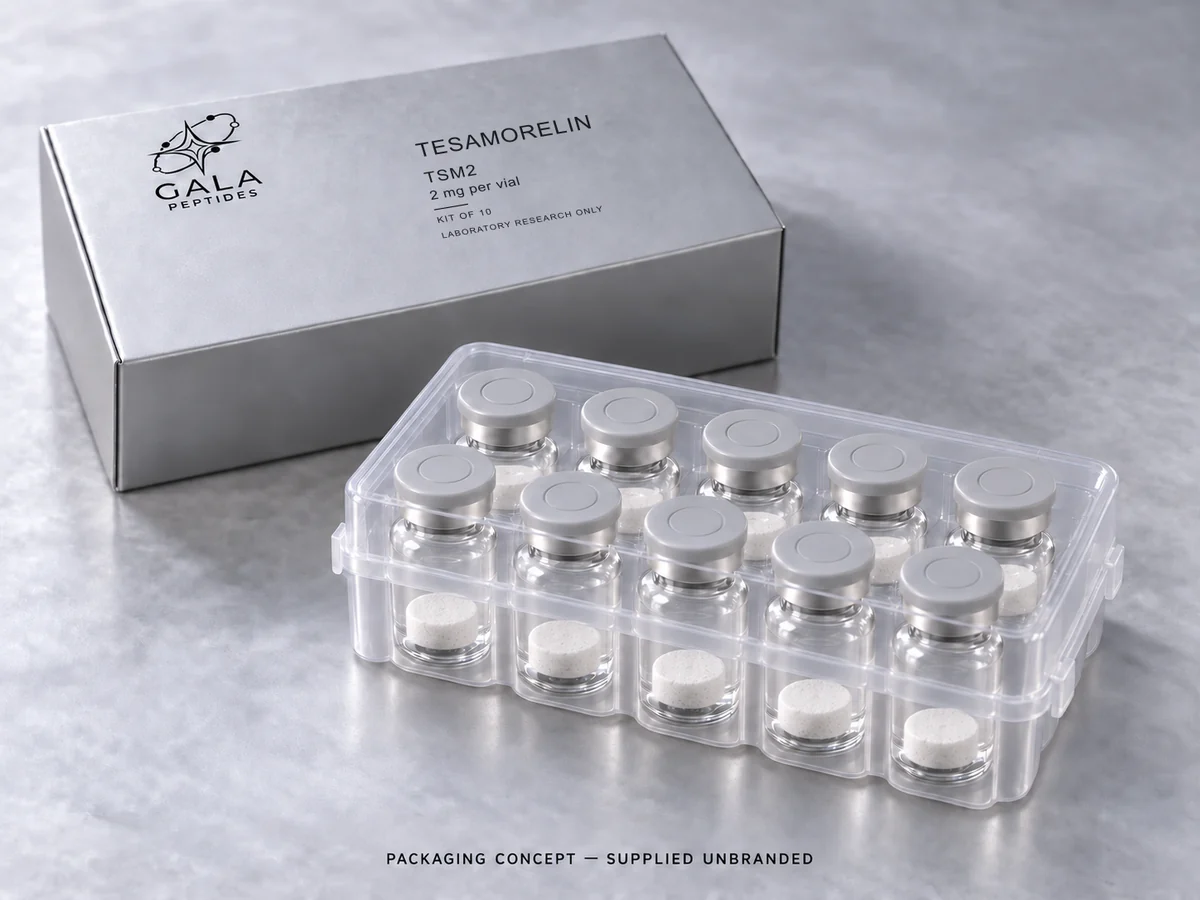
Research kit / TSM2
Tesamorelin
Stabilised 44-residue GHRH analogue with an N-terminal hexenoyl group, studied in models of growth hormone secretion and visceral adiposity.
- SKU
- TSM2
- Amount per vial
- 2 mg
- Unit of sale
- Kit of 10 vials
Shipping excluded. Supplied in plain, unbranded packaging.
For experimental laboratory research only. Not for human or animal use.
Documentation
Certificate of analysis availability may vary by product and lot. Contact us before payment to check availability for your selected kit.
All kit prices
| SKU | Per vial | USD / kit |
|---|---|---|
| TSM2 | 2 mg | $120≈ $12 per vial |
| TSM5 | 5 mg | $226≈ $23 per vial |
| TSM10 | 10 mg | $360≈ $36 per vial |
| TSM20 | 20 mg | $630≈ $63 per vial |
Research reference
Reconstitution concentration
Concentration maths for laboratory solutions. Use the mass of one vial and the final solution volume.
Prefilled from the selected SKU. For blends, this is the total mass per vial.
Assumes the entered volume equals the final prepared solution volume.
Enter positive values to calculate.
Solubility and storage depend on the compound. See the guide.
Literature reference
Research overview
What it is
Tesamorelin, also designated TH9507, is a synthetic analogue based on the 44-amino-acid growth hormone-releasing hormone (GHRH). Its principal target is the GHRH receptor, involved in pituitary signalling and growth hormone secretion. This receptor differs from both the growth hormone receptor and the ghrelin receptor. Tesamorelin is an active ingredient in FDA-approved medicines; that approval does not extend to Gala research kits.
Where it has been studied
The selected literature is predominantly clinical. Falutz and colleagues reported a randomised study and a pooled analysis of two phase 3 trials with extension data in participants living with HIV. Stanley and colleagues examined abdominal and liver tissue measures in a separate randomised study. Research themes include the GHRH–growth hormone–IGF-1 axis, endocrine responses, imaging-based tissue measurements and metabolic observations. The two Falutz papers include overlapping development evidence rather than wholly independent programmes.
Open questions
Open questions concern the influence of population, baseline endocrine state, observation period and measurement method. Circulating biomarkers and imaging endpoints describe different aspects of biology. Understanding their relationship requires assessment within the same study context. Longer observation and evidence from different populations address the generalisability of findings beyond the participants represented in these papers.
References
- Falutz et al. Effects of tesamorelin (TH9507), a growth hormone-releasing factor analog, in human immunodeficiency virus-infected patients with excess abdominal fat: a pooled analysis of two multicenter, double-blind placebo-controlled phase 3 trials with safety extension data. Journal of Clinical Endocrinology & Metabolism, 2010. PMID: 20554713. DOI: 10.1210/jc.2010-0490.
- Falutz et al. Effects of tesamorelin, a growth hormone-releasing factor, in HIV-infected patients with abdominal fat accumulation: a randomized placebo-controlled trial with a safety extension. Journal of Acquired Immune Deficiency Syndromes, 2010. PMID: 20101189. DOI: 10.1097/QAI.0b013e3181cbdaff.
- Stanley et al. Effect of tesamorelin on visceral fat and liver fat in HIV-infected patients with abdominal fat accumulation: a randomized clinical trial. JAMA, 2014. PMID: 25038357. DOI: 10.1001/jama.2014.8334.
Reviewed 2026-10-09 · References describe published study materials; they do not verify supplied lots.